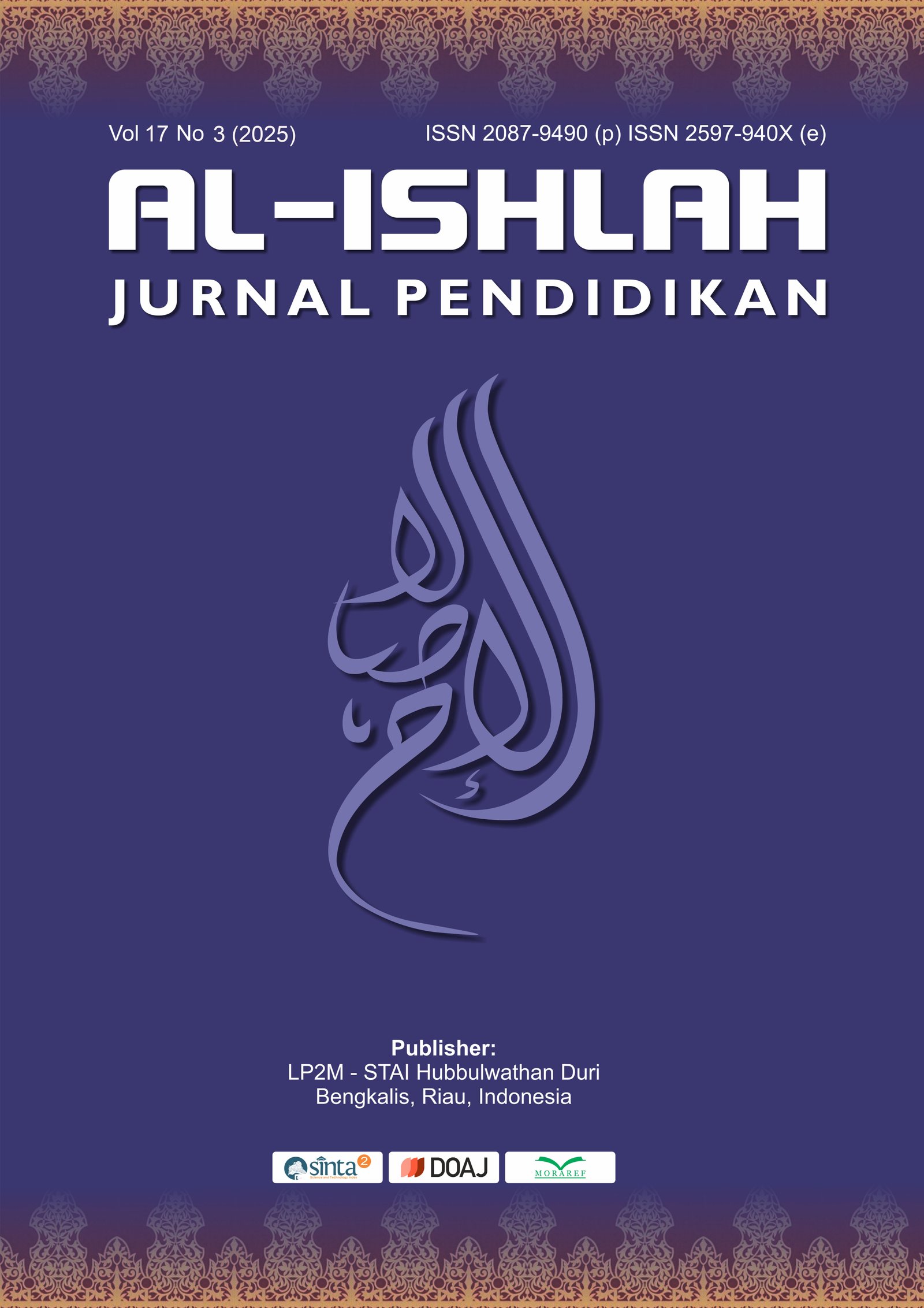
Development of Flipbook Electronic Teaching Materials for Implementing the Scientific Approach in Indonesian Language Learning for Vocational High School Students
DOI:
https://doi.org/10.35445/alishlah.v17i3.5560Keywords:
Flipbook Teaching Materials, Scientific Approach, Indonesian Language LearningAbstract
References
Alam, M. K. (2021). A systematic qualitative case study: Questions, data collection, NVivo analysis and saturation. Qualitative Research in Organizations and Management: An International Journal, 16(1), 1–31. https://doi.org/10.1108/QROM-05-2020-1933
Alzamil, J. (2021). Listening skills: Important but difficult to learn. Arab World English Journal, 12(3), 366–374. https://doi.org/10.24093/awej/vol12no3.25
Aswirna, P., & Ritonga, A. (2020). The development of discovery learning-based e-book teaching e-book based on Kvisoft Flipbook Maker on science literation. HUNAFA: Jurnal Studia Islamika, 17(2), 47–79. https://doi.org/10.24239/jsi.v17i2.617
Calado, F., Scharfenberg, F.-J., & Bogner, F. (2015). To what extent do biology textbooks contribute to scientific literacy? Criteria for analysing science-technology-society-environment issues. Education Sciences, 5(4), 255–280. https://doi.org/10.3390/educsci5040255
Carrete-MarÃn, N., & Domingo-Peñafiel, L. (2022). Textbooks and teaching materials in rural schools: A systematic review. CEPS Journal, 12(2), 67–94. https://doi.org/10.26529/cepsj.1181
Dewi, N. K. A. K. (2022). Discovery learning in e-book with natural science lesson at elementary school. Indonesian Journal of Educational Research and Review, 5(1), 111–122. https://doi.org/10.23887/ijerr.v5i1.40646
Febriati, F., Jaya, D., & Nurhikmah, H. (2022). English teaching materials with flipped learning model in English course. Journal of Education Technology, 6(4), 643–651. https://doi.org/10.23887/jet.v6i4.51080
Halidjah, S., & Pranata, R. (2021). Development of Indonesian language teaching materials based on Google Classroom in primary schools. Journal of Education Technology, 5(2), 298–306. https://doi.org/10.23887/jet.v5i2.35167
Hidayat, R., & Dewantara, D. (2021). The development of electronic teaching materials on linear impulse and linear momentum to improve students’ scientific literacy. Journal of Physics: Conference Series, 2104(1), 012011. https://doi.org/10.1088/1742-6596/2104/1/012011
Hung, I.-C., Kinshuk, & Chen, N.-S. (2018). Embodied interactive video lectures for improving learning comprehension and retention. Computers & Education, 117, 116–131. https://doi.org/10.1016/j.compedu.2017.10.005
Indaryanti, R. B., Harsono, H., Sutama, S., Murtiyasa, B., & Soemardjoko, B. (2025). 4D research and development model: Trends, challenges, and opportunities review. Jurnal Kajian Ilmiah, 25(1), 91–98. https://doi.org/10.31599/jki.v25i1.1580
Iqbal, M. S., & Rahim, Z. A. (2023). The patented technology innovation portfolio on 4D printer using theory of inventive problem solving. In International Conference of Reliable Information and Communication Technology (pp. 173–182). Springer. https://doi.org/10.1007/978-3-031-32132-1_17
Jentoft, N., & Olsen, T. S. (2019). Against the flow in data collection: How data triangulation combined with a ‘slow’ interview technique enriches data. Qualitative Social Work, 18(2), 179–193. https://doi.org/10.1177/1473325017712581
Karkera, S., & Chamundeshawari, C. (2018). YouTube: A teaching tool to improve listening skills. International Journal of Creative Research Thoughts, 6(2), 1311–1316. https://www.ijcrt.org/viewfull.php?&p_id=IJCRT1134455
Kusumayuni, P. N., & Agung, A. A. G. (2021). E-book with a scientific approach on natural science lesson for fifth grade students of elementary school. Jurnal Ilmiah Sekolah Dasar, 5(1), 177–185. https://doi.org/10.23887/jisd.v5i1.33447
Moser, A., & Korstjens, I. (2018). Series: Practical guidance to qualitative research. Part 3: Sampling, data collection and analysis. European Journal of General Practice, 24(1), 9–18. https://doi.org/10.1080/13814788.2017.1375091
Ningsih, N. P. M. H., & Agung, A. A. G. (2024a). Electronic books based with a contextual approach on reading material in Indonesian language content for fourth grade elementary school. Journal for Lesson and Learning Studies, 7(2), 382–391. https://doi.org/10.23887/jlls.v7i2.57262
Ningsih, N. P. M. H., & Agung, A. A. G. (2024b). Electronic books based with a contextual approach on reading material in Indonesian language content for fourth grade elementary school. Journal for Lesson and Learning Studies, 7(2), 382–391. https://doi.org/10.23887/jlls.v7i2.57262
Perdana, F. A., Zakariah, S. H., & Alasmari, T. (2023). Development of learning media in the form of electronic books with dynamic electricity teaching materials. Journal of Educational Technology and Learning Creativity, 1(1), 1–6. https://doi.org/10.56003/jetlc.v1i1.1
Rahmawati, A., & Sujono, F. K. (2021). Digital communication through online learning in Indonesia: Challenges and opportunities. Jurnal ASPIKOM, 6(1), 61–70. https://doi.org/10.24329/aspikom.v6i1.815
Rokhayati, I. T., Prasasti, P. A. T., Maruti, E. S., & Irawan, N. (2022a). Quality of e-book teaching materials with scientific inquiry approach in strengthening science literacy for elementary school students. IJECA (International Journal of Education and Curriculum Application), 5(3), 235–240. https://doi.org/10.31764/ijeca.v5i3.9466
Rokhayati, I. T., Prasasti, P. A. T., Maruti, E. S., & Irawan, N. (2022b). Quality of e-book teaching materials with scientific inquiry approach in strengthening science literacy for elementary school students. IJECA (International Journal of Education and Curriculum Application), 5(3), 235–240. https://doi.org/10.31764/ijeca.v5i3.9466
Rokhayati, I. T., Prasasti, P. A. T., Maruti, E. S., & Irawan, N. (2022c). Quality of e-book teaching materials with scientific inquiry approach in strengthening science literacy for elementary school students. IJECA (International Journal of Education and Curriculum Application), 5(3), 235–240. https://doi.org/10.31764/ijeca.v5i3.9466
Siswanto, D. H., Maretha, D. G. A., & Alghiffari, E. K. (2024). Development of student worksheets assisted by flipbook based on the scientific approach for systems of linear equations with two variables material. Asian Pendidikan, 4(2), 1–9. https://doi.org/10.53797/aspen.v4i2.1.2024
Sulistiani, N. A., & Sukmawati, W. (2024). The relationship between e-book material on grouping animals based on food type and the scientific literacy ability of students in elementary schools. Jurnal Penelitian Pendidikan IPA, 10(7), 3913–3919. https://doi.org/10.29303/jppipa.v10i7.5870
Sulistyani, A. M., Prasetyo, Z. K., Hanum, F., & Rizki, N. P. (2022). Development and validation of e-books during the post-pandemic to improve attitude towards environmental care in case of Indonesia. International Journal of Advanced Computer Science and Applications, 13(4), 167–172. https://doi.org/10.14569/IJACSA.2022.0130420
Utaminingsih, E. S., Intania, B. Y., Aida, H., Salama, M. S., & Sukma, I. M. (2024). Designing an innovative educational framework for “How we live and grow†using the 4D model. The Journal of Educational Development, 12(1), 42–52. https://doi.org/10.31539/jed.v12i1.6354
Van, L. K., Dang, T. A., Pham, D. B. T., Vo, T. T. N., & Pham, V. P. H. (2021). The effectiveness of using technology in learning English. AsiaCALL Online Journal, 12(2), 24–40. https://asiacall.info/acoj/index.php/journal/article/view/57
Vonti, L. H., Ganeswara, M. G., Rahmah, M., & Rosyid, A. (2024). Bilingual e-magazine: The development of digital teaching resource on students’ literacy of environmental pollution. Journal of Education Technology, 8(1), 52–62. https://doi.org/10.23887/jet.v8i1.58817
Wicaksono, A., Supriyono, S., & Akhyar, F. (2021a). Development of electronic teaching materials based Flip Book Makers for language skills in elementary schools. Journal of Physics: Conference Series, 1987(1), 012008. https://doi.org/10.1088/1742-6596/1987/1/012008
Wicaksono, A., Supriyono, S., & Akhyar, F. (2021b). Development of electronic teaching materials based Flip Book Makers for language skills in elementary schools. Journal of Physics: Conference Series, 1987(1), 012008. https://doi.org/10.1088/1742-6596/1987/1/012008
Downloads
Published
How to Cite
Issue
Section
Citation Check
License
Authors who publish with this journal agree to the following terms:
- Authors retain copyright and grant the journal right of first publication with the work simultaneously licensed under a Creative Commons Attribution License that allows others to share the work with an acknowledgement of the work's authorship and initial publication in this journal.
- Authors are able to enter into separate, additional contractual arrangements for the non-exclusive distribution of the journal's published version of the work (e.g., post it to an institutional repository or publish it in a book), with an acknowledgement of its initial publication in this journal.
- Authors are permitted and encouraged to post their work online (e.g., in institutional repositories or on their website) prior to and during the submission process, as it can lead to productive exchanges, as well as earlier and greater citation of published work.