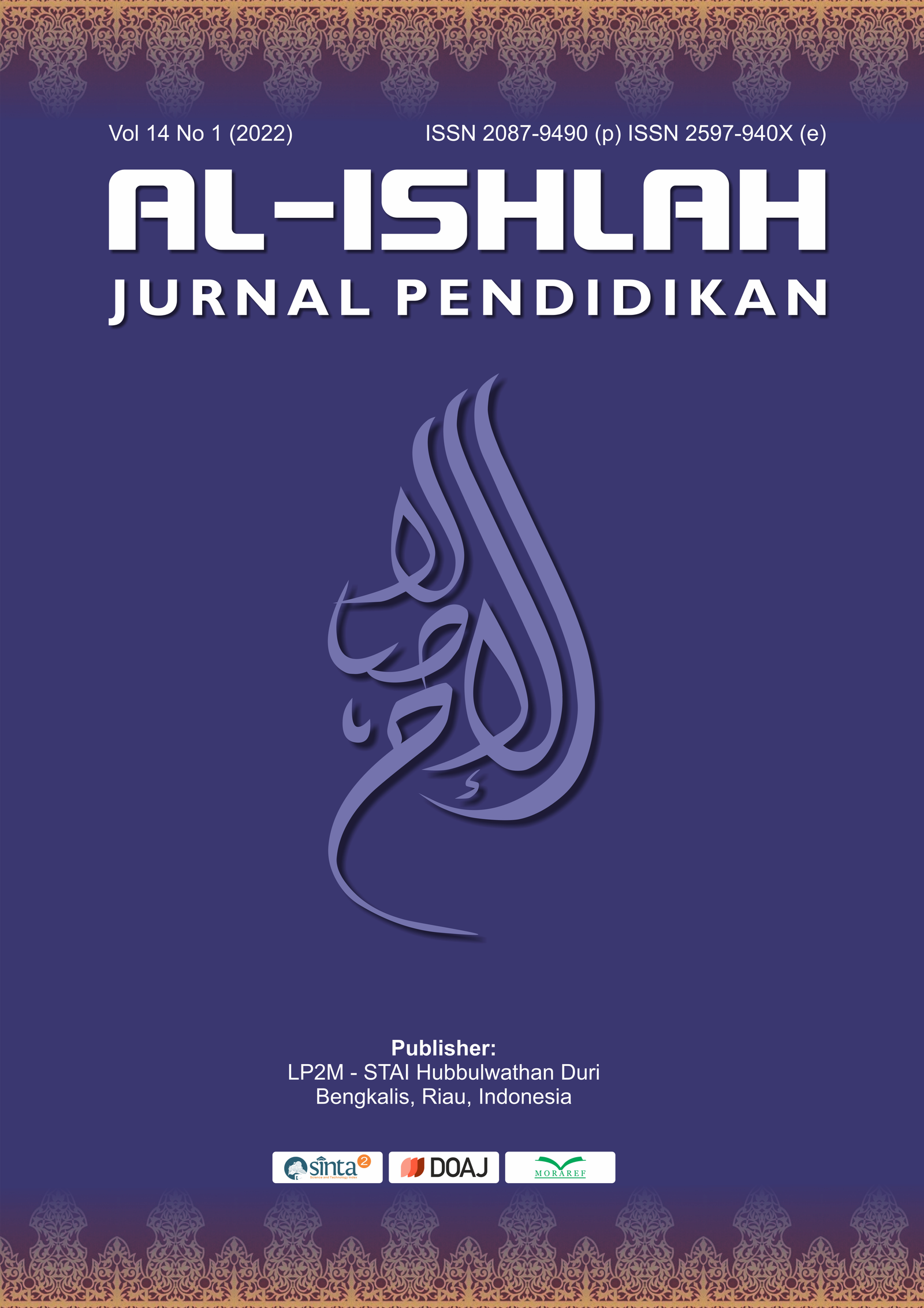
Correlation Between Learning Motivation and Problem-Solving Ability Based on Gender
DOI:
https://doi.org/10.35445/alishlah.v13i3.1127Keywords:
Learning Motivation, Problem Solving Ability, GenderAbstract
References
Acharya, B. R. (2017). Factors affecting difficulties in learning mathematics by mathematics learners. International Journal of Elementary Education, 6(2), 8-15.
Bal-Taştan, S., Davoudi, S. M. M., Masalimova, A. R., Bersanov, A. S., Kurbanov, R. A., Boiarchuk, A. V., & Pavlushin, A. A. (2018). The impacts of teacher’s efficacy and motivation on student’s academic achievement in science education among secondary and high school students. EURASIA Journal of Mathematics, Science and Technology Education, 14(6), 2353-2366.
Deci, E. L., & Ryan, R. M. (2016). Optimizing students’ motivation in the era of testing and pressure: A self-determination theory perspective. In Building autonomous learners (pp. 9-29). Springer, Singapore.
Gattuso, L., & Ottaviani, M. G. (2011). Complementing mathematical thinking and statistical thinking in school mathematics. In Teaching statistics in school mathematics-Challenges for teaching and teacher education (pp. 121-132). Springer, Dordrecht.
Hudha, M. N., & Batlolona, J. R. (2017). How are the physics critical thinking skills of the students taught by using inquiry-discovery through empirical and theorethical overview?. Eurasia Journal of Mathematics, Science and Technology Education, 14(2), 691-697.
Kiemer, K., Gröschner, A., Pehmer, A. K., & Seidel, T. (2015). Effects of a classroom discourse intervention on teachers' practice and students' motivation to learn mathematics and science. Learning and instruction, 35, 94-103.
Kloosterman, P. (2002). Beliefs about mathematics and mathematics learning in the secondary school: Measurement and implications for motivation. In Beliefs: A hidden variable in mathematics education? (pp. 247-269). Springer, Dordrecht.
Kunter, M., Klusmann, U., Baumert, J., Richter, D., Voss, T., & Hachfeld, A. (2013). Professional competence of teachers: effects on instructional quality and student development. Journal of educational psychology, 105(3), 805.
Liou, P. Y., Wang, C. L., Lin, J. J., & Areepattamannil, S. (2021). Assessing students’ motivational beliefs about learning science across grade level and gender. The Journal of Experimental Education, 89(4), 605-624.
Mazana, Y. M., Suero Montero, C., & Olifage, C. R. (2019). Investigating students' attitude towards learning mathematics.
Ojose, B. (2011). Mathematics literacy: Are we able to put the mathematics we learn into everyday use. Journal of mathematics education, 4(1), 89-100.
Rahardjo, A., & Pertiwi, S. (2020). Learning Motivation and Students’ Achievement in Learning English. JELITA, 1(2), 56-64.
Remillard, J. T. (2011). Modes of engagement: Understanding teachers’ transactions with mathematics curriculum resources. In from text to'lived'resources (pp. 105-122). Springer, Dordrecht.
Riswanto, A., & Aryani, S. (2017). Learning motivation and student achievement: description analysis and correlations both. The International Journal of Counseling and Education, 2(1), 42-47.
Retnawati, H., Djidu, H., Kartianom, A., & Anazifa, R. D. (2018). Teachers’ knowledge about higher-order thinking skills and its learning strategy. Problems of Education in the 21st Century, 76(2), 215.
Roza, N., Arnawa, I., & Yerizon, Y. (2018). Practicality of mathematics learning tools based on discovery learning for topic sequence and series. International Journal of Scientific dan technology Research, 7(5), 236-241.
Simamora, R. E., & Saragih, S. (2019). Improving Students' Mathematical Problem Solving Ability and Self-Efficacy through Guided Discovery Learning in Local Culture Context. International Electronic Journal of Mathematics Education, 14(1), 61-72.
Sagala, R., Umam, R., Thahir, A., Saregar, A., & Wardani, I. (2019). The Effectiveness of STEM-Based on Gender Differences: The Impact of Physics Concept Understanding. European Journal of Educational Research, 8(3), 753-761.
Downloads
Published
How to Cite
Issue
Section
Citation Check
License
Authors who publish with this journal agree to the following terms:
- Authors retain copyright and grant the journal right of first publication with the work simultaneously licensed under a Creative Commons Attribution License that allows others to share the work with an acknowledgement of the work's authorship and initial publication in this journal.
- Authors are able to enter into separate, additional contractual arrangements for the non-exclusive distribution of the journal's published version of the work (e.g., post it to an institutional repository or publish it in a book), with an acknowledgement of its initial publication in this journal.
- Authors are permitted and encouraged to post their work online (e.g., in institutional repositories or on their website) prior to and during the submission process, as it can lead to productive exchanges, as well as earlier and greater citation of published work.