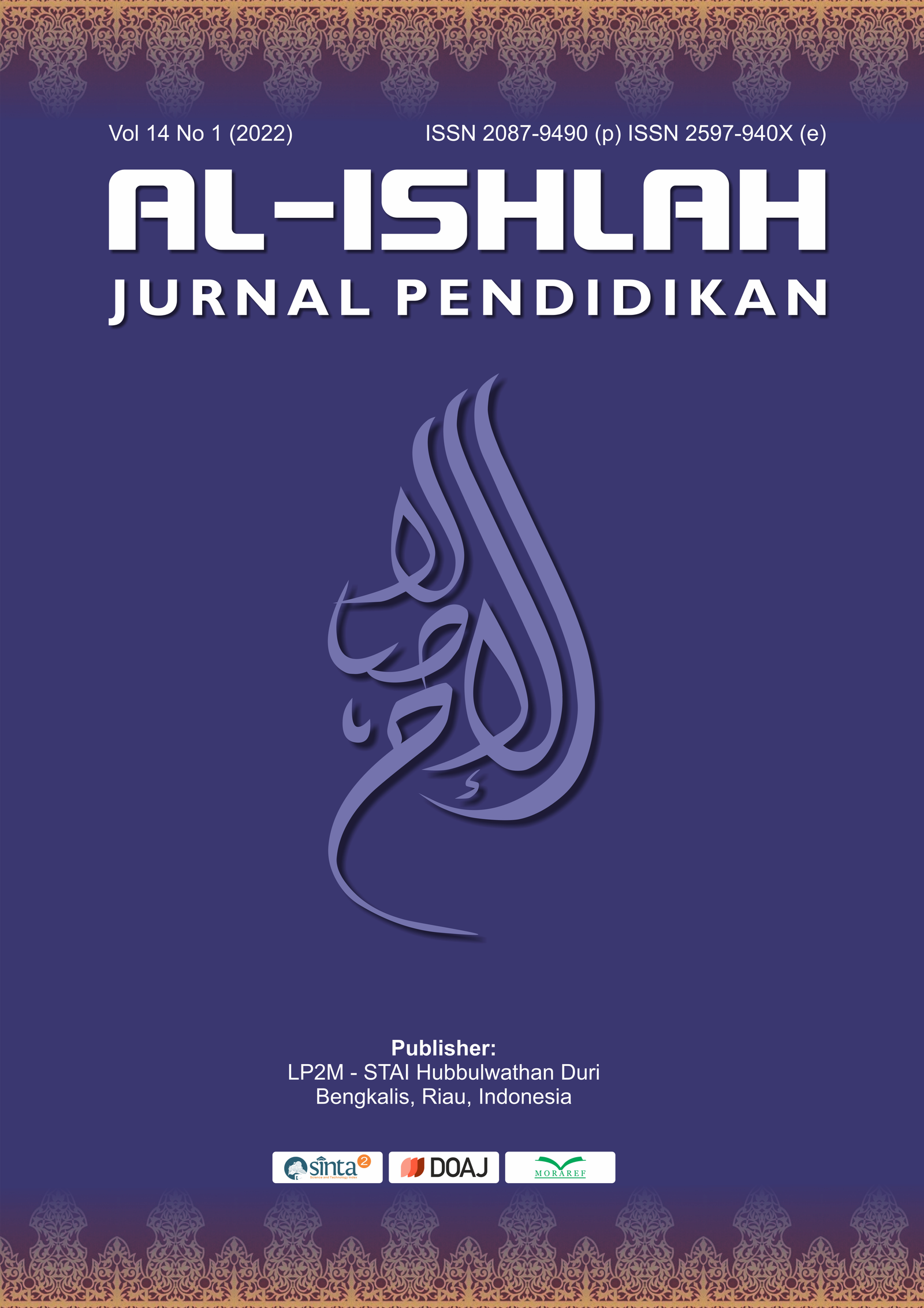
The Physical Fitness Level of Children with Special Needs During the Covid-19 Pandemic In Extraordinary Schools
DOI:
https://doi.org/10.35445/alishlah.v13i3.1021Keywords:
Physical fitness level, The child with special needs, COVID-19Abstract
References
Arifin, Z. (2018). Pengaruh Latihan Senam Kebugaran Jasmani (SKJ) Terhadap Tingkat Kebugaran Siswa Kelas V Di Min Donomulyo Kabupaten Malang. Journal Of Education, 1(1), 22–29. https://doi.org/http://e-journal.staima-alhikam.ac.id/index.php/al-mudarris/.
Azim, S. R. (2019). The Analysis Of The Jumping Smash In The Game Of Badminto. Journal Beijing Moement, 9(1), 671–674.
Bates, L. C., Zieff, G., Stanford, K., Moore, J. B., Kerr, Z. Y., Hanson, E. D., Barone Gibbs, B., Kline, C. E., & Stoner, L. (2020). COVID-19 Impact on Behaviors across the 24-Hour Day in Children and Adolescents: Physical Activity, Sedentary Behavior, and Sleep. Children (Basel, Switzerland), 7(9), 138. https://doi.org/10.3390/children7090138.
Boleng, C. (2015). Physical Activity of Children with Special Needs During The Covid-19 Social Restrictions. Educational Research Journal2, 8(6), 145–157.
Budiwanto, S. (2011). Metodologi Kepelatihan Olahraga. Malang: UM Press.
Dunton, G. F., Do, B., & Wang, S. D. (2020). Early effects of the COVID-19 pandemic on physical activity and sedentary behavior in children living in the U.S. BMC public health, 20(1), 1351. https://doi.org/10.1186/s12889-020-09429-3.
Kuper, H., Banks, L. M., Bright, T., Davey, C., & Shakespeare, T. (2020). Disability-inclusive COVID-19 response: What it is, why it is important and what we can learn from the United Kingdom's response. Wellcome open research, 5, 79. https://doi.org/10.12688/wellcomeopenres.15833.1.
Li X., Zhou, J., Li, N., and Wang, J. (2018). Comparative Biomechanics Analysis Of Hurdle Clearance Techniques. Biomechanics in Sports 11(2): 307-309.
Ferreira, J. T. (2017). The e ff ect of work environment , leadership style , and organizational culture towards job satisfaction and its implication towards employee performance in Parador Hotels and Resorts , Indonesia. International Journal of Multidisciplinary Research and Development, 3(4), 56–69. https://doi.org/10.1108/IJLMA-10-2016-0085.
French, K. E., Werner, P. H., Rink, J. E., Taylor, K., Hussey, K., French, K. E., … Hussey, K. (2020). The Effects of a 3-Week Unit of Tactical , Skill , or Combined Tactical and Skill Instruction on Badminton Performance of Ninth-Grade Students. Internatioan Journal of Physiology, Nutrition and Physical Education, 15(4), 418–438.
Hammad, W. (2017). Sports for Disabilities During The Covid19 Social Restrictions to Improve Physical Fitnessâ€. Journal American Physical Therapy Association, 4(5), 67–87.
King, A. J., Burke, L. M., Halson, S. L., & Hawley, J. A. (2020). The Challenge of Maintaining Metabolic Health During a Global Pandemic. Sports medicine (Auckland, N.Z.), 50(7), 1233–1241. https://doi.org/10.1007/s40279-020-01295-8.
Marco Aguiar, Goreti Botelho, Carlos Lago, V. (2018). Power, Explosive Can, Training Enhance, Significantly. Journal Sport Health, 18(4), 17–32.
Michael, S. L., Merlo, C. L., Basch, C. E., Wentzel, K. R., & Wechsler, H. (2015). Critical connections: health and academics. The Journal of school health, 85(11), 740–758. https://doi.org/10.1111/josh.12309.
Smith, M. A. (2019). Smash in Condition from Different Corner. Journal American Physical Therapy Association, 2(3), 67–76.
Tomm, B. (2019). Training Effect On Quality Of The Badminton Forehand. Internatioan Journal of Physiology, Nutrition and Physical Education, 4(2), 77–85.
Vora, M. (2019). Badminton and Possition Ball in Champion at Ergonomics Values. Journal of Human Movement Studies, 3(4), 99–115.
Williyanto, S., Wira, D., & Kusuma, Y. (2018). The Development Of Badminton Skills Test Instruments for Athletes in Age Groups of Children , Cub , Teenager and Youth. Journal of Human Movement Studies, 7(1), 50–54.
Downloads
Published
How to Cite
Issue
Section
Citation Check
License
Authors who publish with this journal agree to the following terms:
- Authors retain copyright and grant the journal right of first publication with the work simultaneously licensed under a Creative Commons Attribution License that allows others to share the work with an acknowledgement of the work's authorship and initial publication in this journal.
- Authors are able to enter into separate, additional contractual arrangements for the non-exclusive distribution of the journal's published version of the work (e.g., post it to an institutional repository or publish it in a book), with an acknowledgement of its initial publication in this journal.
- Authors are permitted and encouraged to post their work online (e.g., in institutional repositories or on their website) prior to and during the submission process, as it can lead to productive exchanges, as well as earlier and greater citation of published work.