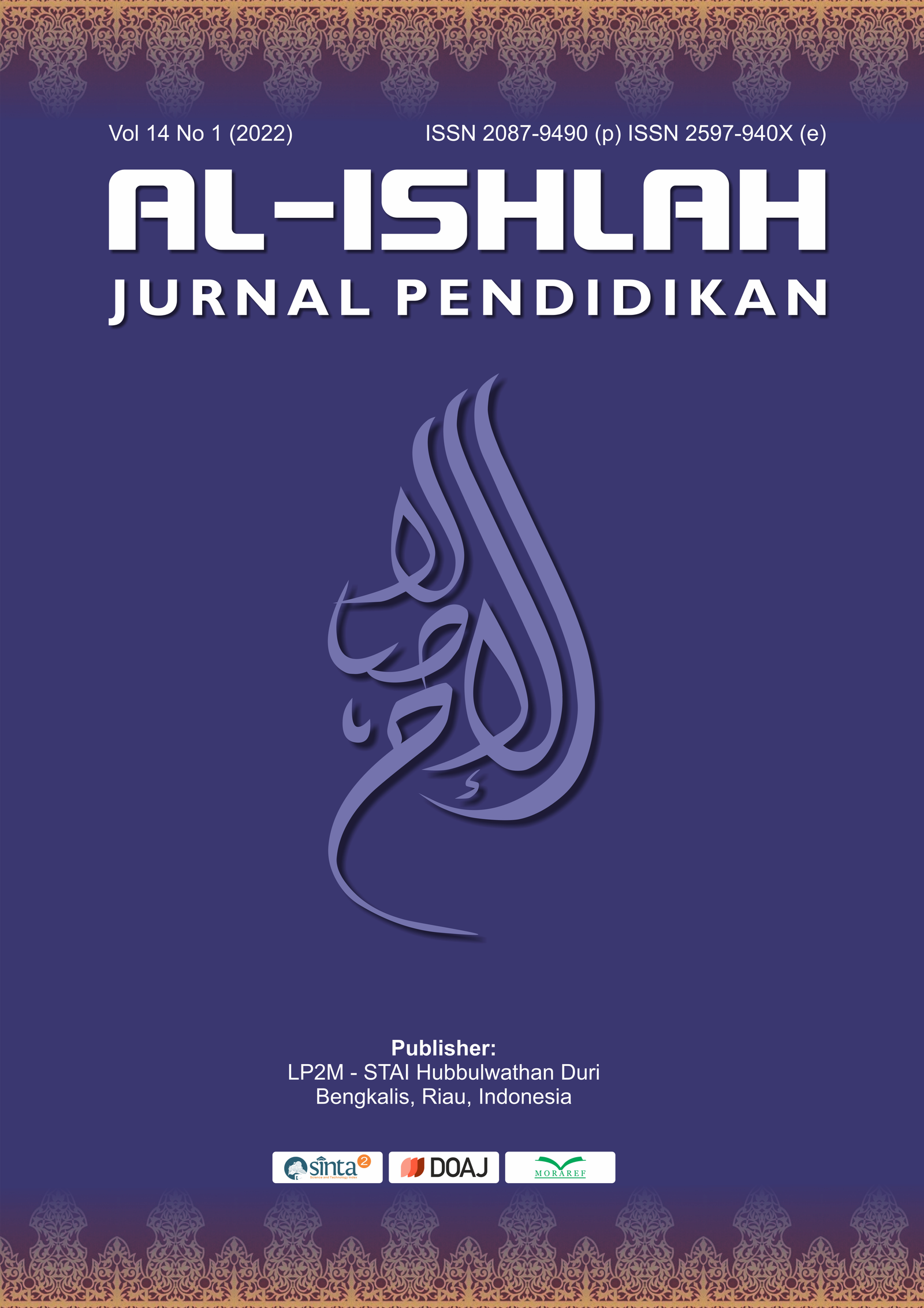
Online Informal Learning of English Activities to Improve Students’ English Communication Skills
DOI:
https://doi.org/10.35445/alishlah.v13i3.1018Keywords:
Communication Skills, Improving English, Online English LearningAbstract
This study aims to learn about students' experiences developing their speaking skills using Online Informal Learning of English (OILE) activities. The researcher gathered data for this narrative study by interviewing and observing three English education students at a State University in Central Java. The data were then evaluated qualitatively. The results indicated that students learned several aspects of speaking and communicating in English using Youtube video content, including pronunciation, intonation, and expressiveness. Additionally, the students used a variety of social media and chat platforms to engage with their international peers in English. Additionally, students favoured this informal learning mechanism because they recognized the efficacy of these online everyday learning activities in pleasantly achieving meaningful learning goals. Additionally, OILE activities aided students' speaking performance during informal learning activities.
References
Bampton, R., & Cowton, C. J. (2002, May). The e-interview. In Forum Qualitative Sozialforschung/Forum: Qualitative Social Research (Vol. 3, No. 2).
Barkhuizen, G., Benson, P., & Chik, A. (2013). Narrative Inquiry in Language Teaching and Learning Research. Routledge.
Creswell, J. W. (2012). Educational Research: Planning, Conducting, and Evaluating Quantitative and Qualitative Research. Pearson.
Creswell, J. W., & Poth, C. N. (2016). Qualitative Inquiry and Research Design: Choosing Among Five Approaches. SAGE Publications.
Godwin-Jones, R. (n.d.). Smartphones and language learning. Language Learning, 15.
JurkoviÄ, V. (2019). Online informal learning of English through smartphones in Slovenia. System, 80, 27–37. https://doi.org/10.1016/j.system.2018.10.007
Klimova, B. (2020). Benefits of the Use of Mobile Applications for Learning a Foreign Language by Elderly Population. Procedia Computer Science, 176, 2184–2191. https://doi.org/10.1016/j.procs.2020.09.255
Lamb, M., & Arisandy, F. E. (2020). The impact of online use of English on motivation to learn. Computer Assisted Language Learning, 33(1–2), 85–108. https://doi.org/10.1080/09588221.2018.1545670
Lee, J. S., & Dressman, M. (2018). When IDLE Hands Make an English Workshop: Informal Digital Learning of English and Language Proficiency. TESOL Quarterly, 52(2), 435–445. https://doi.org/10.1002/tesq.422
Oda, N. (2015). My Hesitation to Speak English. TESOL Journal, 6(4), 790–791. https://doi.org/10.1002/tesj.224
Sockett, G. (2014). The Online Informal Learning of English. Springer.
Song, D., & Bonk, C. J. (2016). Motivational factors in self-directed informal learning from online learning resources. Cogent Education, 3(1), 1205838. https://doi.org/10.1080/2331186X.2016.1205838
Suharyanto, S. (2018). Menyiasati Kegagalan Pembelajaran Bahasa Inggris Sebagai Bahasa Asing. Riksa Bahasa: Jurnal Bahasa, Sastra, dan Pembelajarannya, 4(2), 253–260. https://doi.org/10.17509/rb.v4i2.16382
Toffoli, D., & Sockett, G. (2015). University teachers’ perceptions of Online Informal Learning of English (OILE). Computer Assisted Language Learning, 28(1), 7–21. https://doi.org/10.1080/09588221.2013.776970
Trinder, R. (2017). Informal and deliberate learning with new technologies. ELT Journal, 71(4), 401–412. https://doi.org/10.1093/elt/ccw117.
Downloads
Published
How to Cite
Issue
Section
Citation Check
License
Authors who publish with this journal agree to the following terms:
- Authors retain copyright and grant the journal right of first publication with the work simultaneously licensed under a Creative Commons Attribution License that allows others to share the work with an acknowledgement of the work's authorship and initial publication in this journal.
- Authors are able to enter into separate, additional contractual arrangements for the non-exclusive distribution of the journal's published version of the work (e.g., post it to an institutional repository or publish it in a book), with an acknowledgement of its initial publication in this journal.
- Authors are permitted and encouraged to post their work online (e.g., in institutional repositories or on their website) prior to and during the submission process, as it can lead to productive exchanges, as well as earlier and greater citation of published work.