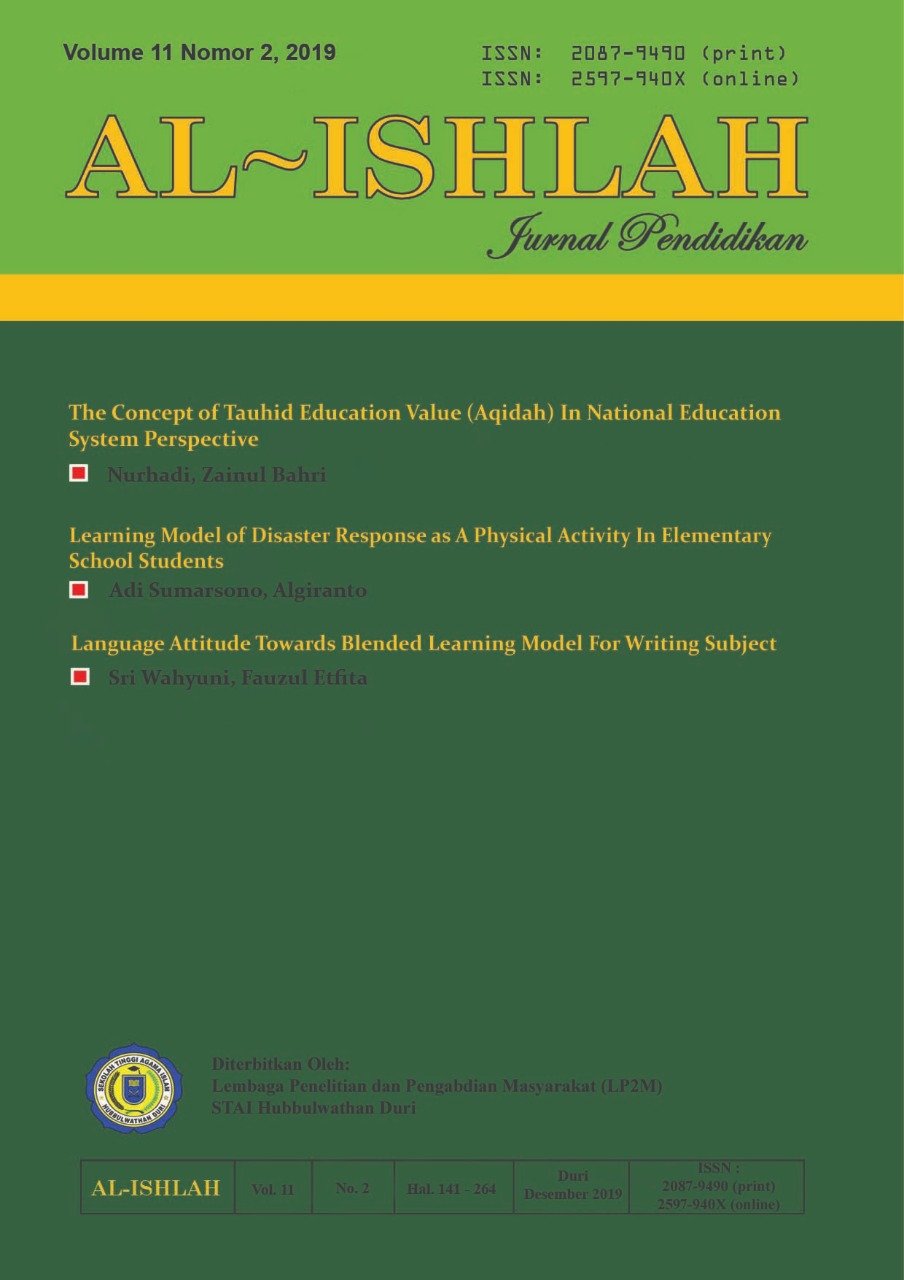
LANGUAGE ATTITUDE TOWARDS BLENDED LEARNING MODEL FOR WRITING SUBJECT
DOI:
https://doi.org/10.35445/alishlah.v11i2.141Keywords:
Blended Learning Model, Language Attitude, Writing AbilityAbstract
The aim of this research is to analyze students’ language attitude towards blended learning model for writing subject. The mix method was applied through the combination of quantitative data and qualitative data. The former was administered to the students through the four-point likert scale survey. The latter was obtained from the interview. The data was processed and computed by employing SPSS 24, then explained descriptively. The result of the study was classified into three categories namely affective, cognitive, and conative. The first was at moderate level with range 2.51--3.50. The second was at moderate level with range 2.51--3.50. The last was at moderate level with range 2.51--3.50. Overall, it is confirmed that the students positively behave on blended learning model in writing subject. In emphasizing the result, the interview illustrated that students showed good attitude on writing subject when taught by using blended learning model.
References
Ahmed, S. (2015). Attitudes towards English language learning among EFL learners at UMSKAL. Journal of Education and Practice, 6(18), 6–17.
Anghelache, V. (2013). Determinant factors of students’ attitudes toward learning. Procedia - Social and Behavioral Sciences, 93, 478–482.
Creswell, J. W. (2013). Research design: Qualitative, quantitative, and mixed methods approaches. Thousand Oaks: Sage Publications.
Djaali. (2014). Psikologi pendidikan. Jakarta: PT. Bumi Aksara.
Etfita, F. (2019). Students’ perspectives on the use of Edmodo as an assessment tool. Journal of English for Academic, 6(1), 18–25.
GarcÃa, R. E. (2013). English as an international language: A review of the literature. Colombia Applied Linguistic Journal, 15(1), 113–127.
Ghavifekr, S., & Rosdy, W. A. W. (2015). Teaching and learning with technology: Effectiveness of ICT integration in schools. International Journal of Research in Education and Science (IJRES), 1(2), 175–101.
Husamah. (2014). Pembelajaran bauran (blended learning): Terampil memadukan keunggulan pembelajaran face-to-face, e-learning offline-online, dan mobile learning. Jakarta: Prestasi Pustaka.
Kljunić, J., & Vukovac, D. P. (2015). A survey on usage of mobile devices for learning among tertiary students in Croatia. In Central European on Information and Intelligent System (pp. 97–104).
Köse, U. (2010). A web based system for project-based learning activities in “web design and programming†course. Procedia - Social and Behavioral Sciences, 2(2), 1174–1184.
Mihajlović, I., & Krželj-Čolović, Z. (2014). The impact of globalisation on the development of tourism within social and economic changes. European Scientific Journal, (August), 108–120.
Norberg, A., Dziuban, C. D., & Moskal, P. D. (2011). A timeâ€based blended learning model. On the Horizon, 19(3), 207–216.
Oroujlou, N., & Vahedi, M. (2011). Motivation, attitude, and language learning. Procedia - Social and Behavioral Sciences, 29, 994–1000.
Shapley, K., Sheehan, D., Maloney, C., & Caranikas-Walker, F. (2011). Effects of technology immersion on middle school students’ learning opportunities and achievement. The Journal of Educational Research, 104(5), 299–315.
Susanto, A. (2013). Teori belajar dan pembelajaran di sekolah dasar. Jakarta: Kencana Prenadamedia Group.
Wahyuni, S. (2018a). Students’ perception of using an android smartphone application as a supplementary learning resource. In Asia Proceedings of Social Sciences (Vol. 2, pp. 115–119).
Wahyuni, S. (2018b). Students’ perspectives on using telegram messenger as a learning media. ELT-Lectura Journal, 5(1), 31–37.
Wahyuni, S. (2018c). The effect of blended learning model towards students’ writing ability. Journal of English for Academic, 5(2), 97–111.
Wahyuni, S., & Etfita, F. (2018). Pengaruh blended learning model dan sikap berbahasa terhadap kemampuan menulis bahasa inggris siswa sekolah menegah atas negeri di Kota Pekanbaru. GERAM (Gerakan Aktif Menulis), 6(1), 1–9.
Wahyuni, S., Putri, M. E., & Ilyas, M. (2015). The effects of teaching media and language attitude towards students’ listening skill at State Junior High Schools in Depok. In Proceedings English Eduticon International Conference (EDUTICON) (pp. 126–134).
Yudi, C., & Widiati, U. (2011). The teaching of English as a foreign language in Indonesia. Malang: Universitas Negeri Malang.
Downloads
Published
How to Cite
Issue
Section
Citation Check
License
Authors who publish with this journal agree to the following terms:
- Authors retain copyright and grant the journal right of first publication with the work simultaneously licensed under a Creative Commons Attribution License that allows others to share the work with an acknowledgement of the work's authorship and initial publication in this journal.
- Authors are able to enter into separate, additional contractual arrangements for the non-exclusive distribution of the journal's published version of the work (e.g., post it to an institutional repository or publish it in a book), with an acknowledgement of its initial publication in this journal.
- Authors are permitted and encouraged to post their work online (e.g., in institutional repositories or on their website) prior to and during the submission process, as it can lead to productive exchanges, as well as earlier and greater citation of published work.